Inference Multi-Model Sample Application
Description
The Inference Multi-Model sample application demonstrates how to run two embedded TensorFlow Lite Micro models on SR110 using the Astra MCU SDK inference APIs.
This sample initializes two infer_job instances and cycles through multiple execution patterns to show synchronization and resource-sharing behavior:
Model 1 synchronous invocation
Model 1 asynchronous invocation followed by Model 2 asynchronous invocation
Callback-chained execution (Model 2 queued from Model 1 callback)
Tensor-arena lock behavior across both models
The sample also prints inference error metrics for each model output using built-in reference outputs.
The latest example structure uses a common application source tree with board-specific hardware setup kept under hw/<BOARD>/. For this app:
Common application sources such as
main.c,inference_multi_model_sample_app.cc, andinference_multi_model_sample_app.hppstay in the app root.Application defconfigs are stored under
configs/.Board and hardware-specific setup is selected from
hw/<BOARD>/, for examplehw/SR110_RDK/.
The application can also be exported and built as a standalone app repository. In that flow, keep this app in its own directory, point SRSDK_DIR to the SDK root, and build from the app directory itself. For the full application workflow model, see Astra MCU SDK User Guide.
Supported Boards
This application supports:
SR110_RDK
Select the defconfig that matches your target board, and the build system will pick the corresponding board-specific hardware setup from hw/<BOARD>/.
Prerequisites
Choose one setup path:
Optional Configuration
You can change tensor-arena behavior in inference_multi_model_sample_app.cc:
ARENA_TYPE = SHARED_TENSOR_ARENA(default): both models share one arenaARENA_TYPE = INDEPENDENT_ARENA: each model uses its own arena
Notes from source behavior:
In callback-chained mode (
Option 2), queue sizing matters. If inference queue depth is too low, deadlock can occur.In simultaneous locking mode (
Option 3), behavior differs depending on shared vs independent arena mode.
Project Configuration Selection
Before building, choose the project configuration (defconfig) that matches both your target board and the transfer mode you want to validate.
You can:
Select the required defconfig directly from the application’s
configs/directory.Run
make list_defconfigsfrom the application directory to list all supported defconfigs.
Available defconfigs:
sr110_rdk_cm55_inference_multi_model_sample_app_defconfig
Building and Flashing the Example using VS Code and CLI
Use the VS Code flow described in the SR110 guide and the VS Code Extension guide:
Build (VS Code):
Open Build and Deploy -> Build Configurations.
Select the inference_multi_model_sample_app project configuration in the Project Configuration dropdown.
Build with Build (SDK+Project) for the first build, or Build (Project) for rebuilds.

Build (CLI):
Build from the application directory itself:
cd <sdk-root>/examples/inference_examples/inference_multi_model_sample_app
export SRSDK_DIR=<sdk-root>
make <app_defconfig> BUILD=SRSDK
For faster rebuilds when only app code changes, reuse the app-local installed SDK package:
cd <sdk-root>/examples/inference_examples/inference_multi_model_sample_app
export SRSDK_DIR=<sdk-root>
make build
If this app has been exported to its own repository, use the same commands from that exported app directory after setting
SRSDK_DIRto the SDK root.
Flash (CLI):
Activate the SDK venv (required for image generation tools):
# Linux/macOS
source <sdk-root>/.venv/bin/activate
# Windows PowerShell
.\.venv\Scripts\Activate.ps1
Generate the flash image:
cd <sdk-root>/tools/srsdk_image_generator
python srsdk_image_generator.py \
  -B0 \
  -flash_image \
  -sdk_secured \
  -spk "<sdk-root>/tools/srsdk_image_generator/Inputs/spk_rc4_1_0_secure_otpk.bin" \
  -apbl "<sdk-root>/tools/srsdk_image_generator/Inputs/sr100_b0_bootloader_ver_0x012F_ASIC.axf" \
  -m55_image "<sdk-root>/examples/inference_examples/inference_multi_model_sample_app/out/sr110_cm55_fw/release/sr110_cm55_fw.elf" \
  -flash_type "GD25LE128" \
  -flash_freq "67"
Flash the firmware image:
cd <sdk-root>
python tools/openocd/scripts/flash_xspi_tcl.py \
  --cfg_path tools/openocd/configs/sr110_m55.cfg \
  --image tools/srsdk_image_generator/Output/B0_Flash/B0_flash_full_image_GD25LE128_67Mhz_secured.bin \
  --erase-all
Flash and Image Generation (VS Code):
Open the Astra MCU SDK VS Code Extension and connect to the Debug IC USB port on the Astra Machina Micro Kit.
Refer to the Astra MCU SDK User Guide for setup details.
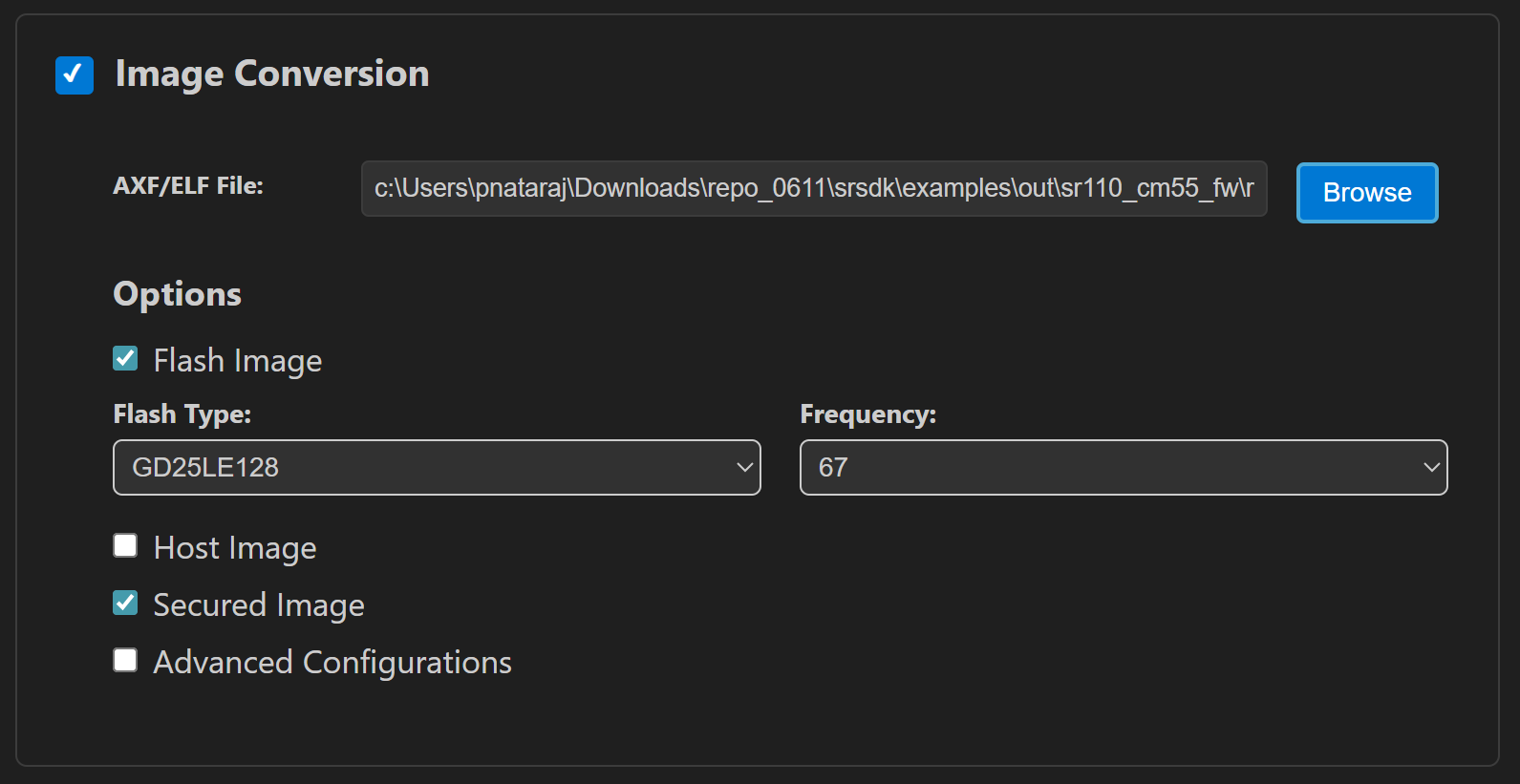
Generate firmware binaries using Build and Deploy -> Image Conversion.
Select the required
.axfor.elffile. If the app was built using the VS Code extension, the file path can be auto-populated.
Flash the application using Build and Deploy -> Image Flashing.
Select SWD/JTAG as the interface.
Choose the generated firmware image and click Run.
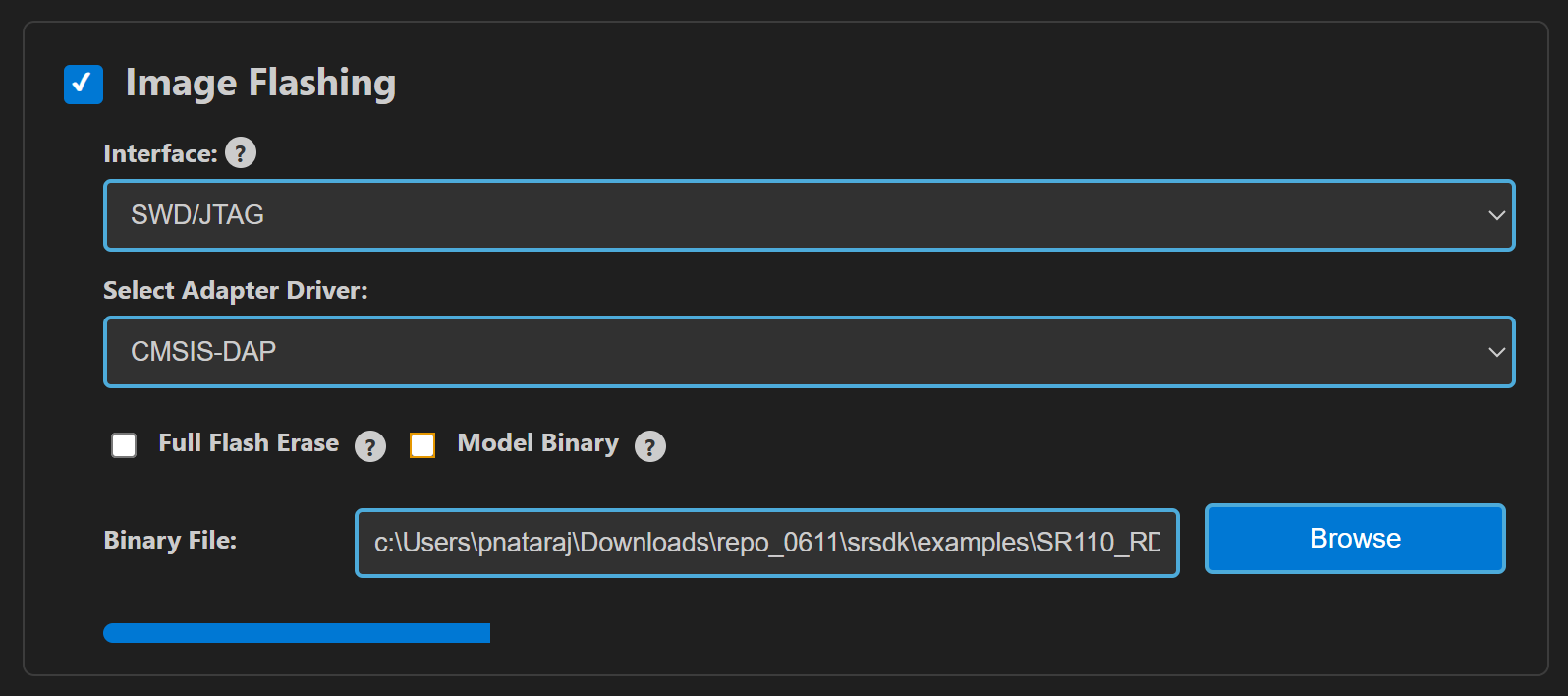
Note: This sample uses models compiled into firmware (
ethosu/model1.ccandethosu/model2.cc). Separate model binary conversion/flashing is not required for default use.
Running the Application using VS Code Extension
Connect a USB cable to the Application SR110 USB port on the Astra Machina Micro board and press RESET.
For logging output, click SERIAL MONITOR and connect to the DAP logger port on J14.
To make it easier to identify, ensure only J14 is plugged in (not J13).
The logger port is not guaranteed to be consistent across OSes. As a starting point:
Windows: try the lower-numbered J14 COM port first.
Linux/macOS: try the higher-numbered J14 port first.
If you do not see logs after a reset, switch to the other J14 port.